




































































President Tinubu Hails MREIF as Fund Delivers ₦128 Billion in Mortgages to 1,859 Nigerian Families
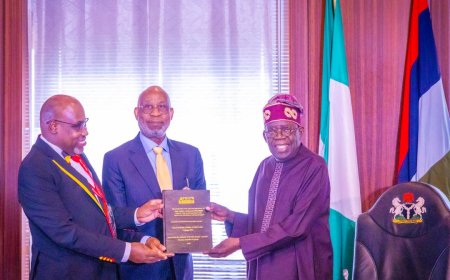
President Bola Ahmed Tinubu has commended the Nigeria Mortgage Refinance Initiative Fund (MREIF) following the disbursement of ₦128 billion in mortgage financing to 1,859 Nigerian families, advancing affordable housing, homeownership, and economic growth.


President Bola Ahmed Tinubu has commended the growing impact of the Ministry of Finance Incorporated Real Estate Investment Fund (MREIF), which has delivered ₦128 billion in affordable mortgages to 1,859 Nigerian families across 25 states under the Renewed Hope Agenda.


The beneficiaries, spread across all the geopolitical zones, have accessed mortgages of up to 20 years at a fixed interest rate of 9.75 per cent per annum with a 10 per cent minimum equity contribution, providing a pathway to home ownership that has largely been unavailable to many Nigerians for almost six decades.
According to President Tinubu, one of the biggest barriers to home ownership in Nigeria has been the absence of affordable long-term mortgage financing.
“For years, many Nigerians could afford monthly rent but could not access the type of financing required to purchase a home. That reality kept countless families out of home ownership and limited their ability to build lasting assets. The progress recorded by MREIF shows that with the right policies, strong institutions and effective partnerships, we can expand access to home ownership and create opportunities for more Nigerians to build wealth through asset ownership,” President Tinubu said.
Beyond the mortgages already delivered, the Fund has unlocked ₦221 billion in total property value and supported the delivery of 475 housing units through offtake guarantee projects.
MORE READ:
- The Cost of Distrust: How Nigeria's Credit Culture Is Killing SME Growth and Economic Development
- 5 Corporate Governance Failures That Cost African Companies Billions - And How to Avoid Them
- Why Africa’s Richest Nations Have Weak Currencies - What Nigeria Must Do Before 2027
- Nigeria - DRC Private Sector Partnership: A New Path for African Industrialisation and Economic Sovereignty
With an average mortgage beneficiary age of 42 years old, MREIF reflects strong demand among working Nigerians who have historically faced limited access to affordable long-term mortgage finance.
President Tinubu also noted that MREIF is one of several complementary engines driving a wider housing transformation under the Renewed Hope Agenda, working alongside the Renewed Hope Cities and Estates Programme and the financing interventions and social housing programmes of Family Homes Funds Limited.
He stressed that affordable mortgage finance is what converts completed units into genuine home ownership, closing the loop between construction and access.
For nearly six decades, Nigeria struggled to build a mortgage market capable of providing affordable long-term housing finance at scale. MREIF, a ₦1 trillion housing finance platform whose pilot phase comprises ₦250 billion in concessionary and commercial funding, was established to help close that gap by mobilising long-term capital for mortgage lending through a combination of government support, private sector management and institutional investment.
Building on the Fund’s early achievements, the administration expects further capital mobilisation to support increased mortgage lending, deepen participation by institutional investors and expand access to affordable housing finance across the country.
MREIF is sponsored by the Ministry of Finance Incorporated and managed by ARM Investment Managers Limited. MREIF’s Series 2 commercial issuance is rated AAA by Agusto & Co. and AA by GCR Ratings, reflecting strong market confidence in the Fund’s structure, governance and long-term sustainability.
Bayo Onanuga
Special Adviser to the President
(Information & Strategy)
June 2, 2026

Probitas Report Intelligence Feedback
The announcement represents one of the most significant developments in Nigeria's housing finance sector in recent years. The delivery of ₦128 billion in mortgage financing to 1,859 families demonstrates that affordable long-term mortgage financing is achievable when government policy, institutional capital, and private sector expertise are properly aligned.
However, while the achievement deserves commendation, it must also be examined through the lenses of scale, affordability, sustainability, and national impact.
The Positives
1. A Breakthrough in Mortgage Finance
For decades, Nigeria's mortgage penetration has remained below 1% of GDP, compared with significantly higher levels in developed and emerging economies.
The provision of:
- Up to 20-year mortgage tenure
- Fixed interest rate of 9.75%
- Lower equity contribution requirements
addresses one of the biggest structural barriers to home ownership in Nigeria.
2. Wealth Creation Through Asset Ownership
Housing is not merely a social good; it is a wealth-building instrument.
The initiative enables families to:
- Build generational wealth
- Reduce long-term rental dependency
- Improve financial security
- Create collateralizable assets
This aligns with global best practices in middle-class development.
3. Institutional Confidence
The AAA and AA ratings obtained by the fund indicate strong confidence from the financial market regarding governance, risk management, and sustainability.
This is critical if Nigeria intends to attract:
- Pension funds
- Insurance funds
- Sovereign capital
- International institutional investors
into the housing finance ecosystem.

The Critical Questions
1. Is 1,859 Families Enough?
While the achievement is commendable, Nigeria faces a housing deficit estimated at over 20 million housing units.
Against this backdrop:
| Indicator | Figure |
|---|---|
| Nigerian Population | Over 230 million |
| Estimated Housing Deficit | 20 - 28 million units |
| Mortgage Beneficiaries | 1,859 families |
| Mortgage Value | ₦128 billion |
The programme is therefore a promising pilot proof of concept but not yet a transformational solution as the percentage of beneficiaries to estimated deficit is inconsequential. The real test is whether the model can scale from thousands to hundreds of thousands of beneficiaries.
2. Can the Average Nigerian Afford the Scheme?
The average beneficiary age of 42 suggests that access may currently favour middle-income earners rather than lower-income Nigerians.
Questions remain:
- What is the average income level of beneficiaries?
- How many beneficiaries are civil servants?
- How many are private sector workers?
- How many are self-employed entrepreneurs?
A truly inclusive housing finance system must eventually accommodate:
- Teachers
- Nurses
- Artisans
- Farmers
- Junior civil servants
- Young professionals
3. Inflation Risk
Nigeria continues to face high inflation. While a 9.75% fixed mortgage rate appears attractive today, sustaining concessionary rates over the long term will require:
- Stable inflation
- Lower government borrowing costs
- Strong capital market participation
- Efficient fund management
Without macroeconomic stability, mortgage affordability may come under pressure.
4. Supply-Side Constraints
Financing alone cannot solve the housing crisis.
Nigeria still faces:
- High building material costs
- Inadequate infrastructure
- Land titling challenges
- Slow approval processes
- Weak urban planning systems
Affordable mortgages without affordable housing supply may eventually create demand-side pressure without solving the underlying deficit.
Probitas Report Economic Intelligence Perspective
The most important takeaway from this development is not the ₦128 billion disbursed. It is the proof that Nigeria can mobilize long-term capital for productive sectors outside oil and government borrowing.
For decades, capital allocation in Nigeria has largely concentrated on:
- Treasury instruments
- Oil and gas
- Commercial trading
MREIF demonstrates that institutional capital can be redirected toward productive asset creation. This is where the real economic significance lies.
Strategic Recommendations
1. Expand the Fund Beyond ₦1 Trillion
Nigeria's housing deficit requires financing measured in trillions of naira annually.
Government should pursue:
- Pension fund participation
- Diaspora housing bonds
- REIT expansion
- Development finance partnerships
2. Link Mortgages to Local Manufacturing
Housing finance should stimulate:
- Cement production
- Steel manufacturing
- Furniture production
- Glass manufacturing
- Electrical materials
This creates jobs while strengthening the Naira through domestic production.
3. Digitize Land Administration
Land titling remains one of the largest barriers to mortgage market expansion.
State governments should accelerate:
- Digital land registries
- Electronic title verification
- Faster consent approvals
4. Introduce Youth Mortgage Programmes
A dedicated housing finance window for young professionals aged 25–40 could accelerate homeownership and strengthen middle-class formation.
Probitas Report Verdict
Rating: 8/10
The MREIF initiative represents one of the most credible and innovative housing finance interventions seen in Nigeria in decades. The programme deserves recognition because it has moved beyond policy announcements to actual mortgage disbursements and measurable outcomes. However, the current scale remains far below the size of Nigeria's housing challenge.
The next phase should focus on:
- Massive scaling
- Broader affordability
- Greater geographic coverage
- Stronger private sector participation
- Housing supply expansion
Quote for Publication
"The success of MREIF should not be measured solely by the ₦128 billion already disbursed, but by its ability to evolve into a national housing finance ecosystem capable of transforming millions of Nigerians from tenants into homeowners. If properly managed, this initiative could become one of the most important economic inclusion programmes in Nigeria's modern history."
... Dr. Ohio O. Ojeagbase
Publisher, Probitas Report
Final Assessment
MREIF is a promising foundation, not a finished solution. Its true success will be determined by whether it can transition from financing 1,859 families today to empowering hundreds of thousands of Nigerian families over the next five years whilst strengthening economic growth, job creation, and national wealth formation.

Contact: report@probitasreport.com
Stay informed and ahead of the curve! Follow The Probitas Report on WhatsApp for real-time updates, breaking news, and exclusive content especially on integrity in business and financial fraud reporting. Don’t miss any headlines, connect with us on social media @probitasreport and visit www.probitasreport.com WhatsApp Only: +234 902 148 8737
[©2026 ProbitasReport - All Rights Reserved. Reproduction or redistribution requires explicit permission.]
What's Your Reaction?