






































































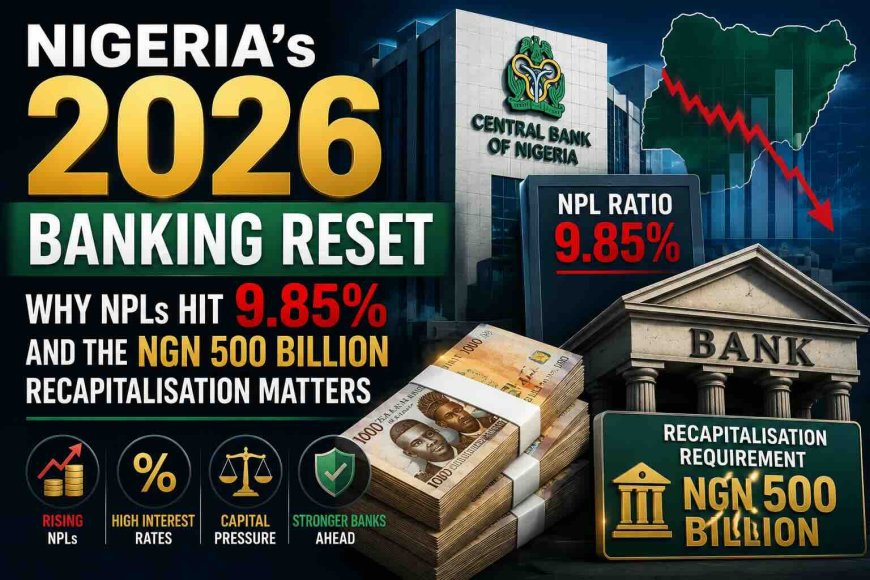
Nigeria's 2026 Banking Reset: Why NPLs Hit 9.85% and the NGN 500 Billion Recapitalisation Matters
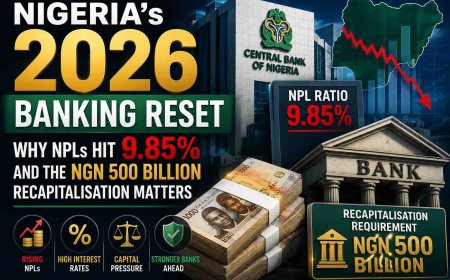
Nigeria's banking sector is entering a new era as NPLs rise to 9.85% and NGN 500 billion recapitalisation reforms reshape lending, governance and competition.



Executive Summary
Nigeria’s banking industry is undergoing its most significant transformation since the consolidation process of 2004. The current recapitalisation drive is proving to be more than just a recapitalisation exercise as the industry seeks to address credit risk, capital adequacy, governance, and overall resilience in the wake of the CBN’s tightening of prudential regulations and the end of years of accommodative monetary policy. The CBN’s tightening of monetary policy, together with persistent high interest rates and increased scrutiny of bank finances, is exposing weaknesses in a number of areas that had festered for too long. The banking sector’s non-performing loan (NPL) ratio has ballooned to 9.85%, compared to the 5% prudential rate at the Central Bank of Nigeria.
At the same time, the banking industry struggles to raise the minimum paid-up capital of NGN500 billion for international commercial banking licenses. Consequently, the industry is being reshaped in ways that go far beyond just a recapitalisation exercise.
Investors, corporates, regulators, and bankers will want to watch this space closely to see which players have the combination of gravitas and agility to navigate the most challenging transition in years. The banking system in Nigeria has entered into a period of reckoning as it searches for a way forward.
Like any financial system, a banking system always undergoes a cycle, and at some point, the banking system reaches a tipping point, which determines the winners and losers of the competition process. For example, the 2008 global financial crisis triggered a wave of reforms in the US banking system and a sovereign debt crisis in Europe. Similarly, the year 2026 is likely to be etched in Nigeria’s banking history as the year of reckoning with the banking system. Although the focus of the debate has so far been on banks’ rising NPLs and the recapitalisation directive, the CBN’s shift in regulatory philosophy is even more important.
The CBN has embarked on a resolution of the banking system that encourages credit risk management, improves capital structure, and strengthens corporate governance. Notably, the exercise is taking place at a time when monetary policymakers are grappling with multiple challenges in the Nigerian economy, including rising inflation, foreign exchange difficulties, surging Nigerian Airways costs, and fiscal adjustments. Therefore, the cost of financing for many Nigerian conglomerates in the industrial, power, oil and gas downstream, construction, import substitution, and service sectors is at its highest level in recent years.

Nigeria: Banking System’s Reset Has Started
Any banking system tends to go through the stage of “baptism of fire,” after which strong institutions emerge while weak ones are weeded out. For the U.S., this stage was the 2008 subprime mortgage crisis; for Europe, it was the sovereign debt crisis. In 2026, Nigeria’s turn has come. The focus of this article is the Nigerian banking system, its recapitalization, and a new wave of delinquencies currently making headlines.
The reason for this development is the CBN’s (Central Bank of Nigeria) efforts to move away from the previous regulatory practice, where “concessional” lending to the private sector was the norm. Going forward, the regulator wants the industry to adopt a more conservative risk management stance, which implies higher capitalization and, therefore, stronger banks. These changes have already triggered the reset of the system.
It is essential to note that the CBN is operating in a challenging macroeconomic environment. In particular, it is dealing with soaring inflation, a weak currency, rising interest rates, downgrades, and a lack of liquidity in the private sector. At the same time, the cost of capital for Nigerian conglomerates, manufacturers, utilities, oil and gas producers, construction companies, agricultural producers, and many other key business sectors is prohibitively high.
Banks are therefore under pressure from both sides. They must continue lending to support growth, yet they are also expected to clean up their balance sheets and raise substantial new equity capital. That combination makes the current moment especially challenging.
READ MORE:
- Professor Emmanuel Ayodeji Appointed Pioneer CEO of ABUAD Business School | A New Era for Executive Education
- Nigeria - DRC Private Sector Partnership: A New Path for African Industrialisation and Economic Sovereignty
- 5 Corporate Governance Failures That Cost African Companies Billions - And How to Avoid Them
- ABUAD Sets New Benchmark as Nigeria's Top University in 2026 Sustainability Rankings
Why NPLs Jumped to 9.85%
The rise in Nigeria’s NPL ratio to 9.85% reflects the expiry of regulatory forbearance, mandatory loan reclassifications, and weaker repayment capacity among highly leveraged borrowers.
It is important not to misread this figure. The sharp increase does not necessarily mean Nigerian businesses suddenly became unable to repay loans in 2026. In many cases, it reflects delayed recognition of credit weakness that had already accumulated under temporary regulatory relief measures introduced during periods of economic disruption.
During the COVID-19 era and its aftermath, regulators around the world introduced relief measures to protect financial stability. Nigeria also permitted banks to restructure eligible facilities without immediately classifying them as impaired. These measures gave both lenders and borrowers some breathing space in an unusually difficult period.
But forbearance was never meant to last forever.
Once those temporary measures expired, banks had to review restructured loans under normal prudential rules. Facilities that no longer had sustainable repayment capacity had to be reclassified according to their true credit status.
That is why the current NPL spike should be understood partly as a transparency event. The system is now showing credit stress more honestly than before.
In the short term, that creates pressure. In the long term, it is healthier for the financial system.

High Interest Rates and Capital Pressure
No serious discussion of the banking crunch can ignore the macroeconomic environment.
Keeping the Monetary Policy Rate (MPR) of the Central Bank of Nigeria at 26.5% indicates the government’s willingness to combat inflation and maintain economic stability. At the same time, the increased rate poses serious risks to businesses due to the high cost of loans. The higher interest rates make it more difficult for borrowers to repay their obligations with banks, thus reducing the amount of money they can spend on consumption and investment. Consumers who take out floating-rate loans will have to pay more to finance their consumption needs, which decreases their purchasing power and, as a consequence, the revenue of businesses involved in production and services. Moreover, the increased cost of loans narrows the choice of financing methods for businesses, which indirectly worsens their financial performance.
Companies that cannot afford to pay off debt obligations may experience deterioration in their financial position and liquidity problems. Many businesses, especially in the manufacturing industry, construction, oil and gas, and energy sectors, are highly dependent on loans. Therefore, a rise in the MPR will damage their profitability and cash flow. Projects that yield high profits at the level of prime rates and have a good risk profile may become unprofitable after the rate hikes, as companies will have fewer lending opportunities and cash flow issues. Thus, banks face significant risks as businesses with deteriorating financial performance are unable to repay their obligations, which harms the quality of the bank’s asset portfolio and loan portfolio.
Why Banks Are Not All the Same
Industry averages can be misleading due to significant variations that exist within the industry.
Some banks typically have more risk, more diverse lending, better underwriting, and more prudent governance than others. The article under review is an example of such a case. These banks have generally remained more resilient.
For example, Sterling Bank has kept its NPL ratio at about 4.93%, remaining below the regulatory threshold and suggesting relatively strong credit control.
By contrast, First Holdco has reported an NPL ratio near 13.9%, showing how exposed some institutions remain to concentrated corporate lending and legacy loan stress.
The lesson is clear. The current environment rewards banks that invested early in governance, credit discipline, portfolio monitoring, and borrower surveillance. It is no longer just about who has the biggest balance sheet.
It is also about management quality.
The banks that come out strongest will not simply be the largest ones. They will be the ones whose boards and executives anticipated exactly this kind of stress and prepared for it.

What the NGN 500 Billion Rule Means
While the NPL story has attracted the headlines, the NGN 500 billion recapitalisation requirement is the more important long-term reform.
The new minimum paid-up capital threshold for international commercial banking licences is a major escalation from earlier requirements. The scale of the capital raise is large, and the effect on market structure will be far-reaching.
Banks that want international licences must now raise NGN 500 billion in paid-up capital. That amount is larger than the market capitalisation of several smaller institutions.
This creates a natural selection process within the sector.
Large banks with strong capital-raising records, diversified funding sources, and market credibility are much better positioned to meet the requirement through retained earnings, rights issues, private placements, or strategic investors.
Smaller banks face a tougher decision.
Some may have no realistic option other than merger or acquisition. Others may choose to reduce their ambitions and apply for national or regional licences instead.
So the recapitalisation rule is more than a prudential measure. It is also a market-restructuring tool. It encourages consolidation, raises barriers to entry, and changes the competitive order of the industry.
The Corporate Debt Clampdown
One of the least discussed but most important aspects of the current transition is the CBN’s corporate debt clampdown.
The leverage ratios previously accepted by many are now coming under review. Concentration limits are also being imposed more stringently. The phenomenon of connected lending as well as insider exposure is also being scrutinized more closely. The situation is particularly acute for corporates based in Nigeria. For them, the era of relying on established banking partnerships to roll over financing or repeatedly refinance loans is coming to an end. The banks have become much more stringent in their lending practices. Collateral requirements, covenant compliance, and transparency are now of primary importance. Some companies find their credit lines reduced, downgraded, or restructured. Others are being placed under enhanced monitoring and must submit more frequent financial reports.
This represents a major change in the bank-customer relationship. The era of passive relationship banking is giving way to active portfolio management, where decisions are driven more by financial evidence than by history or familiarity.

What This Means for Investors and the Economy
For investors, the current environment carries both danger and opportunity.
The risk is that some banks may find themselves having to raise capital on unfavorable terms, diluting existing shareholders or selling assets at a discount to the prevailing book value.
The opportunity is that banks that get through this period will have healthier balance sheets and governance structures in the long run; investors that can spot the survivors will benefit from the rewards.
For the regulators, it is a matter of the CBN’s credibility. Normalizing the provisioning process and allowing for more honest accounting is a sign of a competent regulator, and that competence will be tested severely in the days to come. As such, the CBN will have to tread carefully in its implementation to avoid engendering a credit squeeze.
For the Nigerian economy, success is even more important, as a banking system capable of fulfilling its role as the second pillar of the economy is essential to the country’s growth prospects. If recapitalization and the resolution of non-performing loans take off, they will create the conditions for a stronger economy; if they fail, the costs will be measured in billions of Naira.
What Happens Next
Its problems are far from insurmountable, but the challenges it faces are substantial, and the coming years will be crucial ones for its future. Nigerian banks have weathered a variety of different challenges in the past, from further consolidation rounds to foreign exchange crises and political instability. However, the convergence of these pressures alongside the need to restructure credit/assets, raise new capital, and adapt to a new regulatory environment is certain to make the next few years a trying period for all stakeholders.
The institutions that succeed will be those that understand this is not merely a compliance exercise. It is a reset of how Nigerian banking must operate in a more demanding era.

References
- Central Bank of Nigeria. Prudential guidelines and banking supervision publications.
- Central Bank of Nigeria. Monetary Policy Committee communications.
- Nigerian Deposit Insurance Corporation. Banking industry reports.
- World Bank. Nigeria financial sector assessments.
- PwC Nigeria. Banking industry outlook reports.
- KPMG Nigeria. Banking and capital markets reviews.
About the Author
Dr. Ohio O. Ojeagbase is a Financial Re-engineering Expert, Corporate Governance Specialist, Debt Recovery Strategist, Private Investigator, and founder of Kreeno International. He is widely recognized for his work in non-performing loans (NPLs), financial intelligence, fraud prevention, cognitive governance, and institutional transformation. Through his research, advisory services, and thought leadership, he develops innovative frameworks that help financial institutions, businesses, and public sector organizations transform complex financial and governance challenges into sustainable value creation and long-term institutional resilience.
Contact: report@probitasreport.com
Stay informed and ahead of the curve! Follow The Probitas Report on WhatsApp for real-time updates, breaking news, and exclusive content especially on integrity in business and financial fraud reporting. Don’t miss any headlines, connect with us on social media @probitasreport and visit www.probitasreport.com WhatsApp Only: +234 902 148 8737
[©2026 ProbitasReport - All Rights Reserved. Reproduction or redistribution requires explicit permission.]
What's Your Reaction?