








































































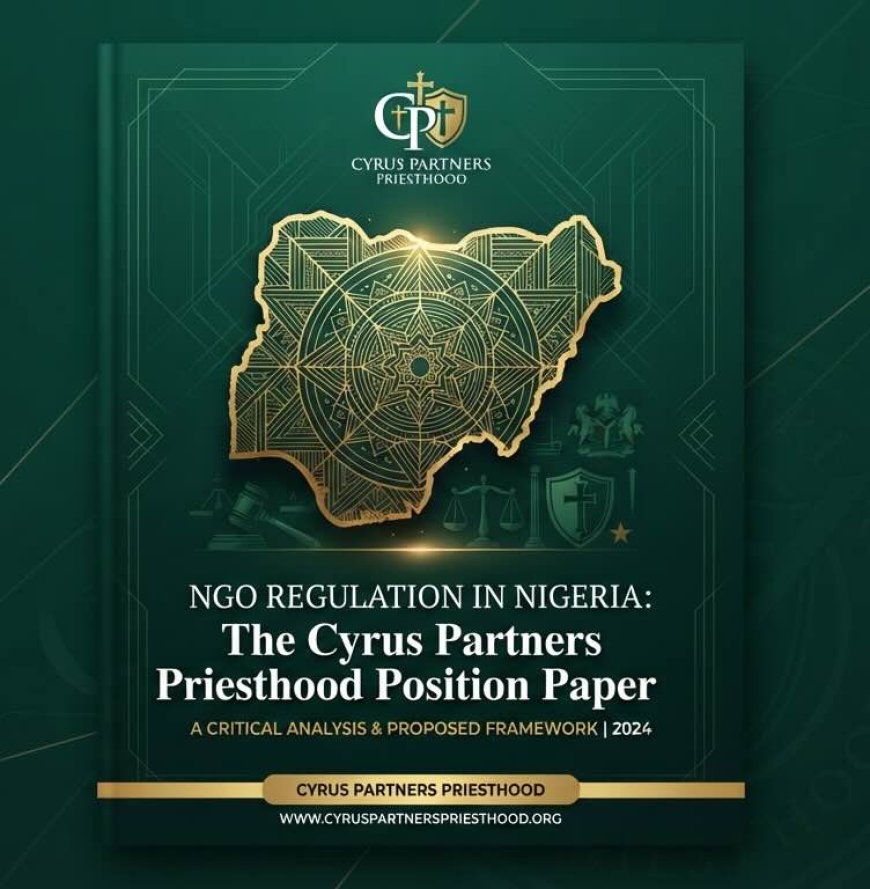
NGO Regulation in Nigeria: The Cyrus Partners Priesthood Position Paper
The Cyrus Partners Priesthood position paper examining Nigeria's NGO regulatory framework, the 2016 NGO Commission Bill, governance, financial accountability, AML/CFT, data protection and Kingdom ministry.

THE CYRUS PARTNERS PRIESTHOOD
POSITION PAPER ON NGO REGULATION, CIVIC SPACE, KINGDOM MINISTRY, AND INSTITUTIONAL COMPLIANCE IN NIGERIA
Subject: Implications of the Non-Governmental Organization Regulatory Commission of Nigeria (Establishment) Bill, 2016 and the Current Regulatory Environment for Faith-Based and Non-Profit Organisations


Prepared for: Apostle Kreeno for The Cyrus Partners Priesthood
Date: August 2026
Status: Policy, Governance and Compliance Position Paper
EXECUTIVE SUMMARY
The Cyrus Partners Priesthood has reviewed the proposed Non-Governmental Organization Regulatory Commission of Nigeria (Establishment) Bill, 2016, which sought to establish a regulatory commission responsible for the supervision, coordination, and monitoring of NGOs and civil society organizations in Nigeria.
The Bill was introduced in the House of Representatives in 2016 as HB 585. It passed second reading on 14 July 2016 and was referred to the relevant committee. Following a public hearing, the Bill stalled at the committee stage and ultimately expired with the dissolution of the 8th National Assembly in July 2019. A subsequent analysis by the Policy and Legal Advocacy Centre states that no further legislative action had been taken on the Bill at the time of its publication. (
The first and most important conclusion of this paper is therefore that the 2016 NGO Regulatory Commission Bill should not be treated as a current Nigerian law. It was a proposed legislative framework that did not become law. Academic and civil society sources also describe it as a bill that failed to pass.
However, the concerns that gave rise to the Bill remain relevant. Nigeria already has a substantial regulatory environment affecting incorporated trustees, charities, faith-based organizations, non-profit organizations, and civil society organizations. The Companies and Allied Matters Act 2020, for example, contains a comprehensive framework for incorporated trustees, including registration, trustees, governance, accounts, accounting records, and annual returns.
There are also current obligations and regulatory expectations arising from anti-money laundering and counter-terrorist-financing legislation and regulations. SCUML's current guidance expressly identifies religious and faith-based organizations among non-profit organizations and provides registration requirements for relevant NPOs.
In addition, organizations handling personal information must take account of the Nigeria Data Protection Act 2023 and the regulatory role of the Nigeria Data Protection Commission.
The position of The Cyrus Partners Priesthood is therefore neither to oppose regulation generally nor to support unnecessary governmental control of legitimate religious and charitable activity. The Priesthood supports lawful accountability, financial integrity, safeguarding, transparency, good governance, and responsible stewardship, while maintaining that legitimate religious and civic activity should retain appropriate constitutional and institutional protections.
The recommended response is consequently preparedness rather than panic.
1. INTRODUCTION
Religious organizations, charitable foundations, non-governmental organizations, and civil society institutions occupy an important position in Nigerian society. They provide humanitarian assistance, education, community development, youth development, social intervention, advocacy, spiritual formation, and other forms of public service.
The Church and Kingdom-oriented institutions have an additional responsibility. They must combine spiritual integrity with institutional excellence.
The Scripture declares:
“Moreover it is required in stewards, that a man be found faithful.” 1 Corinthians 4:2
Faithfulness in this context should include how an organization manages its money, trustees, records, beneficiaries, employees, volunteers, projects, and relationships with government.
The proposed 2016 NGO Regulatory Commission Bill therefore deserves examination not merely as an old piece of legislation, but as part of a continuing conversation about the relationship between government, civil society, religious organizations, and the public.
The Bill's stated objective was to create a commission responsible for supervising, coordinating, and monitoring NGOs and civil society organizations, with an emphasis on transparency and accountability. PLAC records that the Bill contained eight parts and 58 clauses, together with a schedule and explanatory memorandum.
The issue for The Cyrus Partners Priesthood is therefore twofold:
-
What did the proposed Bill seek to do?
-
What lessons should kingdom organizations learn from the Bill and the current Nigerian regulatory environment?
2. THE 2016 NGO REGULATORY COMMISSION BILL
2.1 Origin and legislative history
The Bill was introduced by the Honourable Umar Buba Jubril on 2 June 2016. It passed second reading in the House of Representatives on 14 July 2016 and was referred to the Committee on CSOs and Development Partners. A public hearing was subsequently held, during which civil society organizations expressed significant opposition to aspects of the proposed framework. The Bill remained at the committee stage until the expiration of the 8th Assembly in July 2019.
This history is important because public discussion sometimes treats the Bill as though it became law. It did not.
The Bill therefore has historical and policy significance, but it is not itself the current statutory foundation for regulating NGOs in Nigeria.

3. WHAT THE BILL WAS DESIGNED TO DO
The proposed Commission was intended to provide a central mechanism for regulating NGOs and civil society organizations.
Among the major areas contemplated were:
-
establishment of the regulatory Commission;
-
establishment of its governing board;
-
registration and licensing of NGOs;
-
supervision and monitoring;
-
maintenance of NGO records;
-
coordination of NGO activities;
-
reporting requirements;
-
funding oversight;
-
transitional registration;
-
self-regulation through a proposed national council of voluntary agencies.
PLAC's factsheet specifically identifies registration and licensing, the proposed Nigerian National Council of Voluntary Agencies, and transitional registration as major components of the Bill.
The stated rationale was accountability and transparency.
That objective, in itself, is not inconsistent with good governance.
The difficulty arose around the breadth of governmental powers, the degree of discretion contemplated, duplication of existing regulatory structures, and the potential effect on freedom of association and civic activity.
4. THE MOST SIGNIFICANT CONCERNS
4.1 Additional registration and licensing
One of the most controversial aspects was the proposed requirement for NGOs to register with the new Commission and renew their registration periodically.
Critics argued that NGOs were already operating under the legal framework for incorporated trustees under CAMA and that another compulsory registration and licensing regime could create duplication.
This concern is important because organizations should not be forced into multiple overlapping compliance systems without clear legislative purpose, jurisdiction, and procedural safeguards.
Today, the Corporate Affairs Commission already identifies itself as the Nigerian body responsible for registration, regulation, and maintenance of records relating to incorporated trustees.
4.2 Government discretion
Another concern was the proposed power to refuse registration where the Commission considered an organization's activities not to be in the "national interest."
The phrase is potentially broad.
A regulatory system should distinguish between the following:
legitimate regulation, such as preventing fraud, terrorism financing, financial abuse and misuse of charitable funds,
and
unrestricted administrative discretion, which could potentially interfere with legitimate organisations merely because their activities are unpopular or critical of government.
This was one of the concerns identified by scholars and civic organizations examining the Bill.
4.3 Suspension and cancellation
The Bill also contemplated the ability to suspend or cancel NGO registration.
From a governance perspective, regulatory sanctions can be legitimate where there is fraud, financial misconduct, misuse of donated contributions by religious bodies, criminal activity, or serious non-compliance.
However, a proper regulatory framework should contain the following:
-
clearly defined grounds;
-
notice;
-
opportunity to respond;
-
evidence requirements;
-
proportional sanctions;
-
independent review;
-
appeal procedures;
-
judicial oversight where appropriate.
The Cyrus Partners Priesthood believes that regulation without due process creates uncertainty, while regulation with due process strengthens institutional trust.
5. THE CURRENT LEGAL POSITION
The regulatory environment has evolved considerably since 2016.
5.1 Companies and Allied Matters Act 2020
The current CAMA contains a dedicated framework for incorporated trustees in Part F, covering sections 823 through 850.
The framework addresses:
-
incorporation of trustees;
-
classification of associations;
-
applications;
-
qualification of trustees;
-
constitutions;
-
registration;
-
changes in registered particulars;
-
governing bodies;
-
application of income and property;
-
suspension of trustees;
-
accounting records;
-
statements of accounts;
-
preservation of records;
-
annual returns.
This is significant for religious and charitable organizations.
An organization should therefore not regard incorporation as the end of compliance. Incorporation is the beginning of institutional accountability.
The CAC currently states that its mandate includes the registration and regulation of incorporated trustees and oversight of compliance, annual returns, corporate governance, and record keeping. This is where CAC needs to partner with KREENO GLOBAL regarding the corporate governance framework, which CAC would have to look into for all nonprofit organizations, as it is clear that CAC based on the CAMA of 2020 has tremendous power yet unutilized.

6. ANTI-MONEY LAUNDERING AND TERRORIST FINANCING
This is one area where kingdom organizations should pay particularly close attention.
Nigeria's current regulatory framework includes the Money Laundering (Prevention and Prohibition) Act 2022, the Terrorism (Prevention and Prohibition) Act 2022, relevant SCUML regulations, and other anti-money laundering measures. SCUML's official regulatory page lists the current legal instruments governing its AML/CFT framework.
SCUML's current guidance expressly identifies:
-
humanitarian organisations;
-
charitable organisations;
-
international and local NPOs;
-
religious and faith-based organisations;
-
associations and clubs
within the broader NPO category.
This does not mean that every church or ministry should assume it is automatically subject to every possible financial regulation. The precise obligations depend upon the organization's legal structure, activities, classification, and applicable law.
However, it does mean that financial transparency can no longer be treated as an optional administrative matter.
SCUML's published requirements for relevant NPOs include documentation such as the certificate of incorporation or registration, incorporation of trustees, constitution, and TIN or tax exemption documentation.
7. DATA PROTECTION AND CONFIDENTIALITY
Modern kingdom organizations collect substantial amounts of personal information.
Examples include:
-
members' information;
-
beneficiaries' information;
-
donor information;
-
children's information;
-
volunteers' information;
-
employees' records;
-
prayer requests;
-
counselling records;
-
financial information;
-
photographs and videos;
-
identification documents;
-
online registration information.
The Nigeria Data Protection Act 2023 establishes the legal framework for protecting personal data and safeguarding the rights and interests of data subjects. The NDPC identifies fair, lawful and accountable processing as central objectives of the framework.
This has particular significance for a priesthood operating media, membership, mentoring, or humanitarian or youth programmes.
The principle should be simple:
Do not collect information you do not need, do not expose information you have a duty to protect, and do not retain sensitive information indefinitely without lawful purpose.
8. IMPLICATIONS FOR THE CYRUS PARTNERS PRIESTHOOD
The Cyrus Partners Priesthood should see this regulatory environment as an opportunity to build an institution that can withstand scrutiny.
The Priesthood should aim to become an organization whose books, governance, programmes and activities can be examined without fear because its operations are founded on integrity.
8.1 Corporate governance
The Priesthood should maintain:
-
a clearly defined governing structure;
-
documented responsibilities;
-
trustee records;
-
board or governing council minutes;
-
conflict-of-interest declarations;
-
approval procedures;
-
delegated authorities;
-
financial controls.
No single individual should have unrestricted control over the organization's finances and institutional decisions.
8.2 Financial governance
The Priesthood should establish the following:
A. Proper banking
Kingdom funds should flow through properly authorized organizational accounts rather than informal personal accounts.
B. Segregation of duties
The person who approves expenditure should not necessarily be the same person who initiates, processes, and reconciles the payment.
C. Supporting documentation
Every significant expenditure should have appropriate documentation.
D. Budgeting
Projects should have approved budgets before substantial expenditure begins.
E. Periodic reporting
Leadership should receive periodic financial reports showing income, expenditures, balances, and project commitments.
F. Independent review
Where resources permit, annual accounts should be independently reviewed or audited.
9. DONOR AND PARTNERSHIP GOVERNANCE
The Priesthood should develop a formal Donor and Partnership Due Diligence Policy.
Before accepting significant external funding, it should consider:
-
Who is the donor?
-
Where did the money originate?
-
What is the purpose of the funding?
-
Are there conditions attached?
-
Is the funding consistent with the Priesthood's values?
-
Could accepting the funds create reputational or legal exposure?
-
Are the beneficiaries clearly identified?
-
Can the project be properly accounted for?
The principle should be:
Do not accept money merely because it is available. Accept resources that can be received, managed and accounted for with integrity.
This is consistent with the broader AML/CFT emphasis on preventing nonprofit organizations from being abused for illicit financial purposes. SCUML has specifically highlighted collaboration with NPOs in addressing money laundering and terrorist financing risks.
10. KINGDOM AUTONOMY AND GOVERNMENT REGULATION
The Cyrus Partners Priesthood should distinguish between spiritual authority and legal personality.
Government does not become the owner of the Church because the Church complies with applicable law.
Likewise, compliance does not mean surrendering the spiritual mandate of the Priesthood.
Romans 13:1 provides an important principle concerning governmental authority, while Acts 5:29 reminds believers that obedience to God remains supreme where human commands directly conflict with God's commands.
The appropriate posture is therefore neither rebellion nor unnecessary submission.
It is:
Faithfulness to God.
Respect for lawful authority.
Integrity in administration.
Courage in principle.
Wisdom in engagement.
11. THE CYRUS PARTNERS PRIESTHOOD POSITION
After considering the historical Bill and the present regulatory environment, The Cyrus Partners Priesthood adopts the following position:
Position 1
The Priesthood recognises the legitimate interest of government in preventing fraud, money laundering, terrorist financing, financial abuse, and misuse of charitable structures.
Position 2
The Priesthood supports transparency, financial accountability, responsible governance, and proper stewardship of charitable and Kingdom resources.
Position 3
The 2016 NGO Regulatory Commission Bill should not be represented as current law. Available legislative analysis indicates that it stalled and expired with the 8th National Assembly.
Position 4
Any future regulatory legislation affecting NGOs, religious organizations, or civil society should respect constitutional rights, due process, freedom of association, and legitimate religious activity.
Position 5
Regulation should be proportionate, transparent, and based on clearly defined statutory powers rather than broad discretionary authority.
Position 6
The Priesthood will prepare itself for regulatory scrutiny through stronger governance rather than waiting for legislation to force institutional reform.
12. RECOMMENDED CYRUS PARTNERS COMPLIANCE FRAMEWORK
The Priesthood should establish a Cyrus Partners Kingdom Governance and Compliance Framework, built around eight pillars.
Pillar 1: Legal Identity
Maintain:
-
CAC documentation;
-
constitution;
-
trustee information;
-
registration records;
-
statutory filings;
-
relevant permits and registrations.
Pillar 2: Governance
Maintain:
-
governing council;
-
committee structures;
-
meeting minutes;
-
decision registers;
-
conflict-of-interest policy;
-
delegated authority matrix.
Pillar 3: Financial Integrity
Maintain:
-
annual budgets;
-
bank reconciliation;
-
expenditure approvals;
-
receipts;
-
accounting records;
-
financial reports;
-
annual accounts.
Pillar 4: Donor Integrity
Maintain:
-
donor identification;
-
source-of-funds information where required;
-
donor agreements;
-
project budgets;
-
project reports.
Pillar 5: Programme Accountability
Every major programme should have:
Purpose → Budget → Approval → Implementation → Evidence → Report → Review.
Pillar 6: Data Protection
Develop:
-
privacy policy;
-
consent procedures;
-
data retention policy;
-
access controls;
-
breach response procedures;
-
children's data safeguards.
Pillar 7: Safeguarding
The Priesthood should develop policies covering:
-
children;
-
vulnerable persons;
-
volunteers;
-
counselling;
-
ministry workers;
-
abuse reporting;
-
media and photography.
Pillar 8: Regulatory Intelligence
A designated officer or committee should continuously monitor:
-
National Assembly legislation;
-
CAC requirements;
-
SCUML requirements;
-
tax developments;
-
data protection regulation;
-
relevant state regulations;
-
financial-sector requirements where applicable.
13. STRATEGIC RECOMMENDATION
The Cyrus Partners Priesthood should establish a Legal, Sound Corporate Governance Framework, and Compliance Committee reporting to the appropriate governing authority.
Its mandate should include five responsibilities:
1. Monitor
Identify proposed laws and regulations affecting the Priesthood.
2. Interpret
Assess what each development means for the organization.
3. Prepare
Ensure documentation and institutional structures remain compliant.
4. Engage
Where necessary, engage government agencies, lawyers, accountants, and relevant professional bodies.
5. Protect
Safeguard the Priesthood's legal status, finances, people, reputation, and Kingdom mandate.
This would transform compliance from a reactive activity into an institutional capability.
14. A WORD TO KINGDOM LEADERS
The greatest danger is not regulation itself.
The greater danger is a poor corporate governance structure within the Church.
When kingdom organizations maintain clean records, transparent finances, responsible leadership and credible governance, external scrutiny becomes less threatening.
The Apostle Paul demonstrated this principle when he said the following:
“Providing for honest things, not only in the sight of the Lord, but also in the sight of men.”
2 Corinthians 8:21
Kingdom work must be spiritual, but it must also be responsible.
Prayer does not replace accounting.
Faith does not replace sound corporate governance beyond family ownership.
Anointing does not replace documentation.
Vision does not replace accountability.
And spiritual authority does not excuse financial disorder or governance framework beyond family inheritance.
The stronger the institution becomes, the greater its capacity to serve the Kingdom.
15. CONCLUSION
The proposed 2016 NGO Regulatory Commission Bill represents an important chapter in Nigeria's continuing debate about the regulation of NGOs and civil society organizations. It proposed a central regulatory architecture involving registration, licensing, supervision, monitoring, and accountability. However, available legislative analysis confirms that the Bill did not become law and expired with the 8th National Assembly.
The legal landscape today is different.
CAMA 2020 provides a statutory framework for incorporated trustees, including governance, accounting, and annual-return obligations. Anti-money laundering and counter-terrorist-financing requirements create additional obligations and expectations for relevant nonprofit organizations, including faith-based organizations. The Nigeria Data Protection Act 2023 also introduces important responsibilities for organizations handling personal information.
The appropriate response of The Cyrus Partners Charity should therefore be clear:
We will not operate in fear of regulation. We will operate above reproach.
Our objective should be to build a Kingdom institution whose leadership is accountable, whose finances are transparent, whose programmes are properly documented, whose beneficiaries are protected, whose governance is credible, and whose spiritual mandate remains uncompromised.
The Cyrus Partners Charity should therefore embrace Kingdom excellence, institutional discipline and lawful compliance as part of its stewardship mandate.
The issue is no longer simply whether government may regulate.
The more important question is whether Kingdom institutions are prepared to demonstrate that they can govern themselves with integrity.
That is where the Priesthood must lead.
"Moreover, it is required in stewards that a man be found faithful.” 1 Corinthians 4:2
RECOMMENDED ACTION PLAN FOR THE NEXT 90 DAYS
| Period | Priority Action | Expected Outcome |
|---|---|---|
| Days 1–15 | Legal and governance audit | Identify gaps |
| Days 16–30 | Review CAC and statutory records | Regularise corporate status |
| Days 31–45 | Financial systems review | Strengthen financial controls |
| Days 46–60 | Donor and AML/CFT review | Strengthen source-of-funds controls |
| Days 61–75 | Data protection and safeguarding review | Protect members and beneficiaries |
| Days 76–90 | Board/Leadership compliance session | Adopt permanent governance framework |
Final Position
The Cyrus Partners Priesthood should not wait for another NGO Bill before putting its house in order.
The time to build a transparent, accountable, properly governed and spiritually uncompromising Kingdom institution is now.
Kingdom integrity must be matched by institutional excellence.
What's Your Reaction?