














































































How Men Attending Antenatal Clinics Can Improve Maternal and Child Health in Nigeria
Male involvement in antenatal care can significantly improve maternal and child health outcomes in Nigeria. Discover why men attending antenatal clinics matters for healthier families and safer pregnancies.
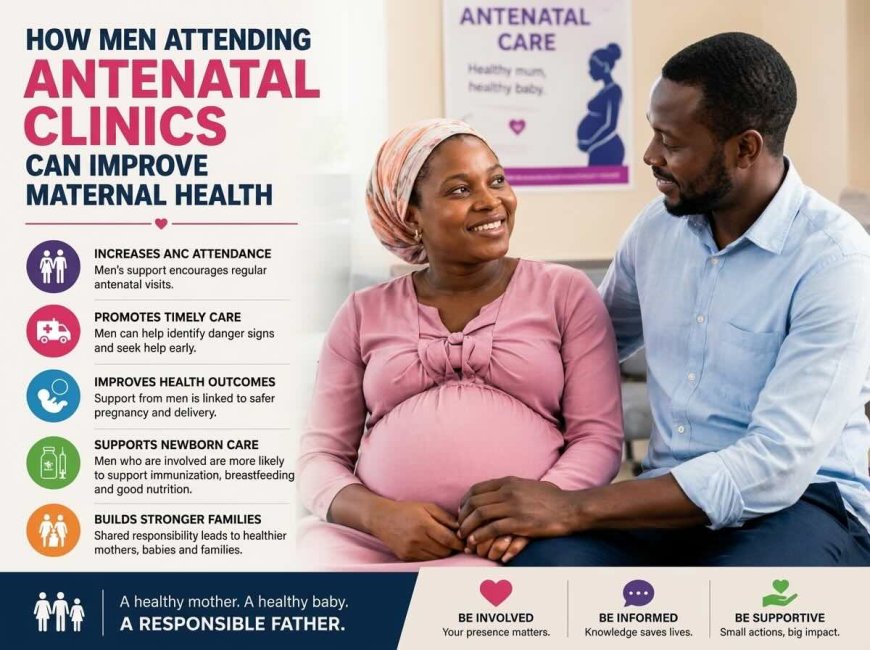

Recently, I visited the hospital to support women during their antenatal clinic day.


“Hello sir, I’m really glad to see you here supporting your wife by making time out of your work schedule to bring her for antenatal care.”
He smiled and replied, “Oh, this is her third pregnancy. I did the same for our first two children. I always try to plan her clinic visits into my schedule. I may not be available for the next one because of a business trip, but I’ll either arrange for someone to bring her or make sure I’m available to pick her up.”
Our conversation continued, but one thing stayed with me afterward: some men are informed, intentional, and actively involved in their wives’ pregnancy journey. That is what we want the future of maternal health to be.

The question is, how do we encourage more men to see maternal and child health not just as a woman’s responsibility or a cultural expectation, but as a shared commitment?
Research continues to show that male involvement improves maternal and child health outcomes, particularly in antenatal care attendance, birth preparedness, immunization, breastfeeding support, and timely healthcare-seeking behavior (Akinyemi et al., 2022).
In Nigeria, men often make important household and healthcare decisions, including where care is sought and how finances are allocated during pregnancy and childbirth. Yet, while many men provide financial support, fewer are physically present during antenatal and postnatal care.
A study conducted in Western Nigeria found that 85.9% of men gave consent for their wives to attend antenatal care, and 79.7% paid for ANC services. However, only 29.2% accompanied their wives to antenatal clinics at least once (Akinyemi et al., 2022).
The same study showed encouraging signs of involvement after childbirth. About 68.2% of fathers supported early initiation of breastfeeding, 65.6% ensured newborn immunization at birth, and 84.7% supported balanced nutrition for their children.
Research from Northern Nigeria also found that men are often the primary decision-makers regarding delivery location, transportation, and emergency care. However, many rarely attend antenatal visits because pregnancy is still viewed culturally as “a woman’s responsibility.” Social expectations, demanding work schedules, and even unfriendly attitudes from healthcare workers can discourage male participation (Ditekemena et al., 2019).
More concerning is recent data from UN Women showing that only 3.4% of men accompany their spouses to antenatal or postnatal clinic visits in Nigeria (The Sun Nigeria, 2024).
This highlights an important gap and an opportunity at the same time.
When men are better informed and actively involved, maternal and child health outcomes improve. Greater male participation can increase antenatal attendance, encourage skilled birth delivery, improve immunization uptake, support better nutrition practices, and promote earlier healthcare-seeking for mothers and newborns.
Supporting pregnancy should not be limited to financial provision alone, presence, partnership and shared responsibility matter.
Sometimes, support begins with simply showing up.


MORE READ:
- Lagos International Financial Centre: Nigeria’s New Economic Blueprint
- How Corporate Governance Drives the Survival and Growth of Emerging Enterprises
- Why Strong Corporate Governance Is the Secret to African Business Survival
- Digital Governance in Nigeria, Why Corporate Boards Must Treat AI, Cybersecurity and Data Ethics as Fiduciary Duties
Contact: report@probitasreport.com
Stay informed and ahead of the curve! Follow The Probitas Report on WhatsApp for real-time updates, breaking news, and exclusive content especially on integrity in business and financial fraud reporting. Don’t miss any headlines, connect with us on social media @probitasreport and visit www.probitasreport.com WhatsApp Only: +234 902 148 8737
[©2026 ProbitasReport - All Rights Reserved. Reproduction or redistribution requires explicit permission.]
What's Your Reaction?